Melting Snow
July 10, 2026
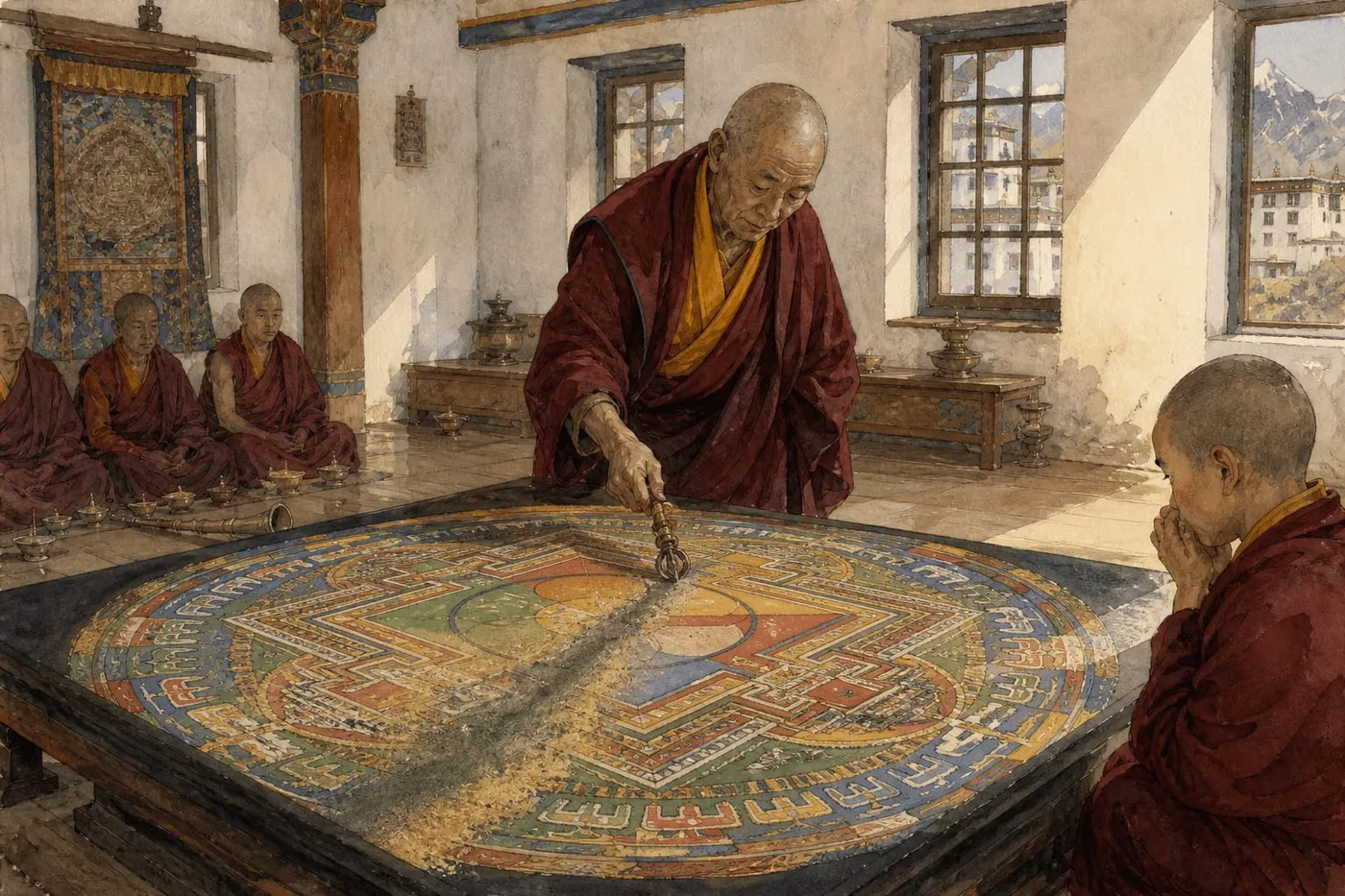
They work on it for days, sometimes weeks. Four monks at the four sides, bent close over the boards, tapping the metal funnels so that coloured sand comes out in a thread finer than a pencil line. Everything about the process argues that this matters: the geometry measured and re-measured, the palace and its gates, colours laid grain against grain, backs aching, the whole thing built inward toward a centre.
Then, when it is finished and has been seen, they take a vajra and draw it through the middle. The rest is swept up — the whole palace, all of it, mixed into a grey-gold heap in a matter of minutes — and carried down to the nearest running water and poured in.
Visitors sometimes find this hard to watch, which is the point at which the teaching starts. The sweeping is not a comment on the work. It is the completion of it.
The sūtra preserved in the Kangyur names four things people hold hardest: health, youth, prosperity, and life itself. All four, it says, are of the nature of change. Read once, that is bleak.
But run it the other way. If nothing held that property, nothing could go the other direction either. A broken heart would be a permanent condition. The frightened child would remain a frightened child for sixty years. Winter would not end. What you do not yet understand you would never come to understand, and the person you are today would be the last person you ever got to be.
The same fact takes things away and makes every recovery possible. There is no version where only the first half applies.
We do the same thing today, mostly by negotiating: the difficult season should end quickly, the good one should stay. Life does not take these terms.
So when it is good, be there for it rather than demanding it sign something.
And when it is bad, remember what is also true of that.
This is real. It is not permanent.
Explore further: Rituals & Sacred Arts · Everything Changes